



14,069 people live in Downtown and West Campus, where the median age is 41 and the average individual income is $136,156. Data provided by the U.S. Census Bureau.
Total Population
Median Age
Population Density Population Density This is the number of people per square mile in a neighborhood.
Average individual Income
Few pockets of Austin tell the city's story as completely as Downtown and West Campus. Sitting shoulder to shoulder along the Colorado River and the western edge of the University of Texas, these two neighborhoods represent the twin engines of Austin's identity: a high-rise professional core humming with tech capital and Michelin-recognized dining, and a dense, student-driven ecosystem that has functioned as the city's intellectual heartbeat for more than 140 years. For buyers, sellers, and investors, understanding how these two neighborhoods interact, and where they diverge, is the difference between a good real estate decision and a great one.
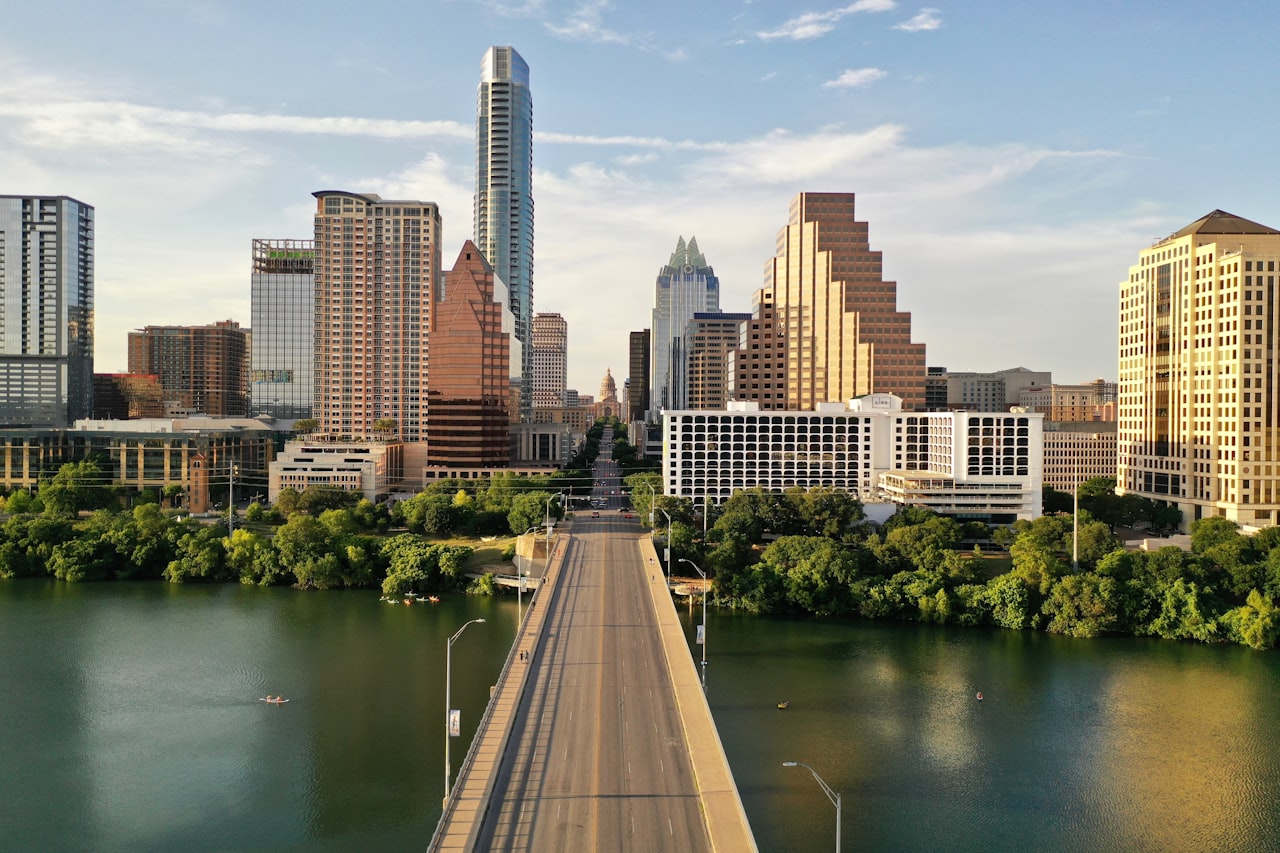
Downtown Austin occupies the original 640-acre grid that Edwin Waller drafted in 1839, bounded roughly by Lady Bird Lake to the south, Martin Luther King Jr. Boulevard to the north, Interstate 35 to the east, and Lamar Boulevard to the west. This one-square-mile footprint holds the state Capitol, the central business district, the Rainey Street entertainment corridor, the Warehouse District, the Seaholm District, and the 2nd Street retail zone.
West Campus sits directly north of Downtown, wedged between the University of Texas at Austin to the east and the historic Old West Austin neighborhood to the west. Guadalupe Street, universally known as "The Drag," forms the seam between the UT campus and the residential blocks of West Campus. The two neighborhoods are separated by only a handful of blocks, and residents routinely walk, bike, or take a ten-minute CapMetro shuttle between them. Together they form the densest, most walkable stretch of real estate in Central Texas.
The story of both neighborhoods begins with the Waller Plan of 1839. When Mirabeau B. Lamar chose a bluff above the Colorado River as the capital of the Republic of Texas, Edwin Waller laid out a strict grid bounded by Shoal Creek and Waller Creek, with Congress Avenue cutting straight through the middle toward the future Capitol building.
The arrival of the Houston and Texas Central Railroad in 1871 turned Downtown into a logistics hub, and when the University of Texas opened in 1883, the residential enclave immediately northwest of the grid, then known as West Hill, began its slow transformation. Grand Victorian estates gradually gave way to Greek life houses and private student dormitories, and by the mid-20th century the neighborhood had rebranded itself as West Campus.
Both neighborhoods struggled through the post-war decades. Suburban flight hollowed out Downtown to the point where the streets emptied by 5:00 PM, and West Campus aged in place without significant reinvestment. The modern renaissance began in the early 2000s and accelerated sharply after the 2004 University Neighborhood District (UND) zoning overlay unlocked vertical density in West Campus. Similar rezoning in Downtown pockets like Rainey Street transformed low-rise blocks into some of the tallest residential towers in Texas. What was once a nine-to-five commercial district became, in less than two decades, an 18-hour residential ecosystem.
Although the two neighborhoods share a border, the people who live in them exist in almost entirely different life stages.
West Campus is one of the most densely populated residential areas in Texas, and its demographics are dominated by the University of Texas. The median age hovers around 21 years old, with nearly three-quarters of residents between the ages of 15 and 24. Median household income sits around $32,000 to $33,000, but that number reflects the reality of a student population living on part-time work, parental support, and financial aid rather than any signal of local economic distress. Roughly 87 percent of West Campus properties are tenant-occupied. The culture is defined by cooperative housing, active Greek life, late-night study routines, and a rhythm that follows the academic calendar rather than the workweek.
Downtown Austin skews in the opposite direction. It is one of the wealthiest zip codes in Central Texas, populated by tech executives, attorneys, political consultants, and corporate transplants, alongside a growing base of affluent empty nesters who have traded suburban maintenance for lock-and-leave high-rise living. The population leans heavily toward professionals aged 25 to 40 and couples without children. Residents prioritize walkability, short commutes, proximity to the Lady Bird Lake trail system, and immediate access to the dining and cultural scene. Both wealthy renters and long-term condo owners are well represented, and the neighborhood is split into distinct residential pockets, including Rainey Street, the Seaholm District, and the Warehouse District, each with its own character.
Few places in Texas offer the architectural contrast found in Austin's urban core. Downtown's skyline is defined by 21st-century vertical construction. The Independent, widely known as the "Jenga Tower" for its cantilevered offset floors, and the Austonian anchor the modern skyline, both featuring floor-to-ceiling glass, rooftop pools, and amenity floors that rival luxury hotels. Rainey Street offers a stranger and more compelling architectural conversation. A handful of 1920s craftsman bungalows still operate as bars and lounges directly at the base of towers like 44 East Ave and the rising 74-story Waterline, creating a streetscape where a porch swing sits in the literal shadow of a residential skyscraper. The Warehouse District tells a third story, with early 20th-century brick warehouses converted into high-ceilinged lofts that preserve original masonry alongside exposed ductwork and industrial steel windows.
West Campus is where Austin's density experiment is most visible. Under the University Neighborhood District overlay, the standard housing type is now a five-to-fifteen-story student mid-rise podium, engineered to maximize bed count while offering hotel-caliber amenities like resort pools, private study lounges, and package concierge service. Woven between these modern podiums are grand Greek Revival mansions housing UT's fraternities and sororities, along with a scattering of early 1900s craftsman bungalows and mid-century brick buildings that operate as student cooperatives, or co-ops, defined by their painted murals, shared kitchens, and collaborative living arrangements.
Downtown Austin is a premium market that has settled into a measured, buyer-friendly correction after the volatility of the pandemic-era boom. The median sale price currently sits at roughly $559,000, down approximately 11 percent year-over-year, while the median price per square foot has actually ticked up about 4 percent to around $705. That divergence tells the real story: smaller premium one-bedroom and junior one-bedroom layouts continue to trade at strong per-foot rates, while larger luxury units are adjusting downward to move.
Properties are sitting on the market longer than they did during the frenzy years, with a median time to sale of around 106 days, and the average sale-to-list ratio hovers near 94.7 percent. In practical terms, that means buyers today are routinely negotiating concessions, price reductions, and interest-rate buy-downs from sellers, particularly on larger floor plans. High-quality presentation and realistic pricing are non-negotiable for sellers who want to capture attention in an environment where inventory has grown and buyers have become more selective. On the rental side, an influx of new multifamily supply across central Austin has slightly cooled rents, which gives urban professionals a bit more breathing room when weighing a lease against a purchase.
West Campus operates on an entirely different real estate cycle than the rest of Austin. The market is insulated by a captive rental base of more than 50,000 UT students, and it moves according to the academic calendar rather than interest-rate headlines or corporate relocation trends. The single most important thing to understand about this market is the per-bed pricing model. Institutional developers and private landlords rarely price by the unit. A four-bedroom apartment is not leased to a group for $4,000; it is leased to four individual students at $1,000 to $1,200 per bed, which dramatically inflates gross rental yield per square foot.
The investment landscape splits cleanly in two. On one side are the institutional mega-developments, largely owned by private equity firms and student housing conglomerates that dominate the West Campus skyline. On the other side is the private condo market, where smaller mid-century and late-90s buildings offer entry-level investment opportunities with a median sale price around $282,000. This lower barrier to entry is why West Campus has one of the most active parent-buyer markets in Texas, with families frequently purchasing a condo for a child to occupy during college and then leasing it to future students for years afterward.
The math is compelling. While Downtown luxury condos often generate cap rates in the 4 percent range, West Campus properties routinely deliver cap rates between 5.5 and 7.0 percent. The tradeoff is operational discipline. The pre-leasing window for the following academic year peaks between October and January, ten months in advance. Miss that window, and a unit can sit vacant for a full 12-month cycle.
Downtown and West Campus are the only two neighborhoods in the Austin metro where living completely car-free is genuinely realistic. Both post Walk Scores in the high 80s and low 90s, placing them in "Walker's Paradise" territory on national mobility indexes.
In West Campus, foot traffic is the dominant transportation mode. Guadalupe Street, "The Drag," functions as a pedestrian highway along the western edge of the UT campus, lined with bookstores, coffee shops, and fast-casual restaurants. CapMetro operates a dedicated UT shuttle system that is free with a student ID and loops through the neighborhood every few minutes during class hours, and multiple bus corridors run south along Guadalupe and Lavaca Streets, connecting a West Campus apartment to a Downtown office in a 10 to 15-minute ride. Downtown adds a broader infrastructure layer, including the Ann and Roy Butler Hike-and-Bike Trail wrapping the northern shore of Lady Bird Lake, protected two-way bike lanes along 3rd and 4th Streets, and the southern terminus of the CapMetro Rail line at the Downtown Station near the Convention Center, which connects riders to East Austin, the North Austin tech corridor, and the suburbs.
The economics also push residents away from car ownership. A single parking space in a Downtown or West Campus building typically runs $150 to $250 per month, on top of already-elevated HOA fees or rent. Combined with dockless electric scooters, e-bikes, and abundant rideshare, most core-urban residents find that owning a car is more expensive and less convenient than going without one.
Austin's urban core is not one nightlife district but several, each with its own personality and clientele. Rainey Street is the most visually striking. Once a quiet row of 1920s craftsman homes on the southeastern edge of Downtown, it now operates as a stretch of bungalow bars, including staples like Banger's Sausage House & Beer Garden, sitting at the base of towers like Paseo and the rising Waterline. Rainey today blends daytime patio-hopping with upscale hotel bar culture, and it has become the default entry point for professionals who want a lively but polished evening.
Sixth Street tells two very different stories on either side of Congress Avenue. East Sixth, historically known as "Dirty Sixth," is the nine-block corridor famous for neon lights, cheap drinks, and weekend pedestrian closures. It is currently in the middle of a significant transformation. Under the Austin Core Transportation Plan approved in early 2026 and major property investments led by firms like Stream Realty, the corridor is shifting toward cocktail rooms, sit-down restaurants, and boutique retail, including the arrival of New York's acclaimed Dead Rabbit. West Sixth Street, by contrast, has long been the playground for the downtown professional crowd, home to trendy sports bars, upscale culinary concepts, and lounges like Whiskey Tango Foxtrot.
The Drag serves an entirely different purpose. Running along Guadalupe on UT's western edge, it is the cultural spine of student dining, defined by counter-service icons like Texas Chili Parlor, fast-casual taco shops, boba tea storefronts, and late-night pizza windows built around student budgets and unpredictable study schedules.
Downtown and West Campus remain the custodians of the "Live Music Capital of the World" identity, even as Austin has grown into a major tech and finance hub. The Red River Cultural District, on the northeast edge of Downtown, is the sanctuary for the city's grittier live music scene, with Stubb's Bar-B-Q hosting national touring acts in its amphitheater and venues like Cheer Up Charlies keeping local indie, rock, and electronic music alive seven nights a week. For jazz and blues, the basement-level Elephant Room downtown offers a subterranean, speakeasy-style room with live performances every single night of the year.
The historic institutional side of the arts scene is equally strong. The Paramount Theatre has anchored Congress Avenue since 1915 and functions as a red-carpet epicenter for the SXSW Film Festival and the Austin Film Festival. The Contemporary Austin at the Jones Center, also on Congress, presents rotating modern art exhibitions and open-air rooftop programming. And just up the road, the UT cultural cluster brings the Blanton Museum of Art, home to more than 21,000 works and Ellsworth Kelly's stone monument Austin, together with the Texas Performing Arts network at Bass Concert Hall, which hosts touring Broadway productions, symphonies, and international operas at the edge of West Campus.
For all its concrete and glass, the urban core has more usable green space than most people expect. The crown jewel is Lady Bird Lake, the dammed section of the Colorado River that forms Downtown's southern border. It functions as a non-motorized water playground for paddleboarders, kayakers, and rowing teams, and it is wrapped by the 10-mile Ann and Roy Butler Hike-and-Bike Trail, which serves as the collective backyard of every downtown high-rise resident.
On the western seam between West Campus and Old West Austin, Pease Park and the Shoal Creek Greenbelt provide 84 acres of ancient live oak canopies, limestone bluffs, and running streams. The recent Kingsbury Commons revitalization added an architectural treehouse sphere, splash pads, and bocce courts, and the park has become an essential decompression zone for UT students. Inside the Downtown grid itself, Waterloo Park on the northeast edge offers elevated walkways, native plantings, and the Moody Amphitheater, a world-class outdoor music venue. Republic Square, tucked into the warehouse and financial districts, hosts yoga sessions, outdoor films, and the vibrant SFC Downtown Farmers' Market every Saturday morning.
Education is not just an amenity in the urban core, it is the economic and cultural anchor. The University of Texas at Austin sprawls across more than 430 acres immediately adjacent to West Campus, home to more than 52,000 students and 24,000 faculty and staff. The University Neighborhood District overlay was specifically designed to absorb the housing demand generated by UT, and the result is a seamless boundary where residents step out of a modern high-rise and walk directly onto campus grounds within minutes.
For K-12 families, the options directly inside the urban core are limited but strong, all served by the Austin Independent School District. Following the historic Pease Elementary's transition into an early childhood education hub via United Way in 2020, most Downtown and West Campus families feed into Mathews Elementary in nearby Clarksville, which holds an "A" rating from the Texas Education Agency and emphasizes inclusive design thinking and multicultural curriculum. From there, students proceed to O. Henry Middle School and then to Austin High School. Founded in 1881 and nestled along the banks of Lady Bird Lake just west of Downtown, Austin High is the oldest public high school in Texas and offers specialized academy tracks in global studies, science, and technology.
Errands in the urban core look nothing like errands in the suburbs. Instead of sprawling parking lots and big-box strip centers, residents rely on a mix of walkable retail districts and condensed micro-amenities. The anchor grocery store is the 80,000-square-foot Whole Foods Market flagship at 5th and Lamar, which doubles as the global headquarters of the brand and functions as much like a community social hub as a supermarket, complete with food halls, wine bars, and a rooftop plaza. To serve the density of West Campus, Target operates a flexible urban-format store on Guadalupe inside Dobie Mall, trimming the suburban SKUs in favor of grab-and-go groceries, dorm essentials, and pharmacy needs. And scattered across Downtown blocks, the homegrown Royal Blue Grocery network stocks locally roasted coffee, prepared meals, and pantry basics for walk-in traffic.
Retail follows a similar logic. The 2nd Street District spans six blocks downtown and skips generic mall chains entirely in favor of local boutiques like United Apparel Liquidators, jewelers like Eliza Page, and Austin institutions like Toy Joy. On The Drag, the mix leans heavily toward university culture, anchored by the multi-level University Co-op, the primary source for UT textbooks, apparel, and gear, and rounded out by independent print shops, vintage clothing racks, and campus bookstores.
Living in Austin's core comes with a distinct financial profile that surprises many out-of-state buyers. Texas has no state income tax, which means local governments generate the majority of their revenue through property assessments. The combined effective property tax rate for central Austin properties generally falls between 1.8 and 2.5 percent of appraised market value, layered across the City of Austin (roughly $0.574 per $100 of assessed value), Austin ISD, which represents the largest share, and Travis County, which funds regional healthcare, emergency services, and infrastructure. For primary residences, the General Homestead Exemption is essential. It caps annual taxable value increases at 10 percent per year and reduces school district taxable valuation, providing a meaningful buffer against rising assessments.
For Downtown condo buyers, the mortgage is only one part of the monthly picture. Luxury high-rise HOA dues typically run $500 to more than $1,200 per month, scaling with unit size and view. Those dues cover the intensive engineering demands of a high-rise, 24/7 concierge and security, controlled-access elevators, fitness centers, pool maintenance, and master building insurance. Two additional line items catch buyers off guard. Parking is a premium commodity, and many Downtown condos convey with only a single unassigned garage space; adding a second secured spot easily adds $150 to $250 per month. And high-rises often use centralized chilled-water HVAC loops rather than individual compressors, which are highly efficient in Texas summers but may involve shared sub-metering or central facility fees billed through the HOA.
Buying, selling, or investing in Downtown or West Campus requires a level of local fluency that only comes from decades inside the market. Kathryn Scarborough is a fifth-generation Austinite with more than $2 billion in active, pending, and sold inventory since 2001, and she remains one of the most consistently recognized Realtors® in Texas. In 2026, RealTrends Verified ranked her the #5 real estate professional in Austin, #14 in Texas, and #303 in the United States, and the Austin Business Journal has previously ranked her the #1 Realtor® in the city. She is a member of the Engel & Völkers Private Office, a designation reserved for the top .001 percent of Texas Realtors®, as well as Austin's Elite 25 and Luxury League. Her expertise spans downtown high-rise living, Lake Austin waterfront, luxury estates, and West Campus investment property, delivered through a concierge-level, tailored client experience backed by a global referral network. Whether you are purchasing your first downtown condo, positioning a West Campus investment property, or listing a legacy home, Kathryn and her team are ready to guide the process from first showing to closing.
Kathryn Scarborough Real Estate Group | Engel & Völkers Austin 3700 Bee Caves Rd., Suite 102, Austin, TX 78746 Phone: (512) 970-1355 Email: [email protected]
There's plenty to do around Downtown and West Campus, including shopping, dining, nightlife, parks, and more. Data provided by Walk Score and Yelp.
Explore popular things to do in the area, including Break Time, Advocare Distributor-Debbie Walker, and Kevin's Cookies & Deli.
| Name | Category | Distance | Reviews |
Ratings by
Yelp
|
|---|---|---|---|---|
| Dining | 0.15 miles | 0 reviews | 0/5 stars | |
| Dining | 0.2 miles | 0 reviews | 0/5 stars | |
| Dining | 0.2 miles | 0 reviews | 0/5 stars | |
| Dining | 0.2 miles | 0 reviews | 0/5 stars | |
| Dining | 0.2 miles | 0 reviews | 0/5 stars | |
| Dining | 0.2 miles | 0 reviews | 0/5 stars | |
| Shopping | 0.2 miles | 0 reviews | 0/5 stars | |
| Active | 0.06 miles | 1 review | 5/5 stars | |
| Active | 0.2 miles | 0 reviews | 0/5 stars | |
| Active | 0.2 miles | 9 reviews | 2.3/5 stars | |
| Active | 0.21 miles | 0 reviews | 0/5 stars | |
| Nightlife | 0.18 miles | 2 reviews | 4.5/5 stars | |
| Beauty | 0.06 miles | 0 reviews | 0/5 stars | |
| Beauty | 0.06 miles | 0 reviews | 0/5 stars | |
| Beauty | 0.15 miles | 0 reviews | 0/5 stars | |
| Beauty | 0.15 miles | 0 reviews | 0/5 stars | |
| Beauty | 0.2 miles | 0 reviews | 0/5 stars | |
| Beauty | 0.2 miles | 2 reviews | 5/5 stars | |
| Beauty | 0.2 miles | 0 reviews | 0/5 stars | |
| Beauty | 0.2 miles | 0 reviews | 0/5 stars | |
| Beauty | 0.2 miles | 0 reviews | 0/5 stars | |
| Beauty | 0.2 miles | 0 reviews | 0/5 stars | |
| Beauty | 0.21 miles | 2 reviews | 5/5 stars | |
|
|
||||
|
|
||||
|
|
||||
|
|
||||
|
|
||||
|
|
Downtown and West Campus has 9,578 households, with an average household size of 1. Data provided by the U.S. Census Bureau. Here’s what the people living in Downtown and West Campus do for work — and how long it takes them to get there. Data provided by the U.S. Census Bureau. 14,069 people call Downtown and West Campus home. The population density is 14,898 and the largest age group is Data provided by the U.S. Census Bureau.
Total Population
Population Density Population Density This is the number of people per square mile in a neighborhood.
Median Age
Men vs Women
Population by Age Group
0-9 Years
10-17 Years
18-24 Years
25-64 Years
65-74 Years
75+ Years
Education Level
Total Households
Average Household Size
Average individual Income
Households with Children
With Children:
Without Children:
Marital Status
Blue vs White Collar Workers
Blue Collar:
White Collar: